Medusa: The True Story of the Gorgon Behind the Legend
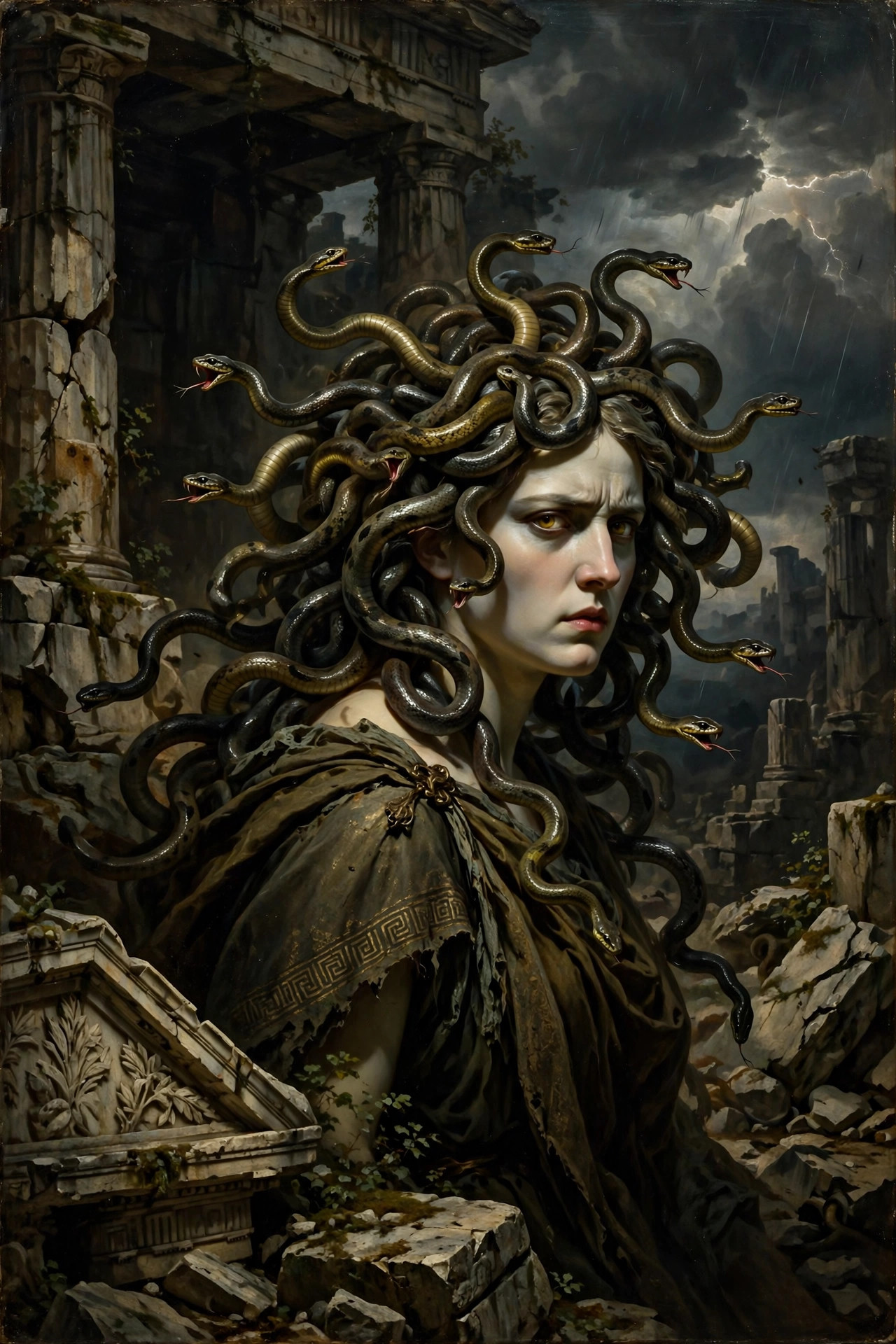
Of all the figures in Greek mythology, none has a face more famous — or a story more misunderstood — than Medusa. Carved on temples, painted by masters and reimagined in every century since, she is remembered as a monster. The oldest poets, however, told a more complicated tale: Medusa was not always a creature of horror, and in some versions she was not the villain of her own story at all.
Who Was Medusa?
Medusa was one of the three Gorgons, daughters of the sea gods Phorcys and Ceto. Her sisters, Stheno and Euryale, were immortal. Medusa alone was mortal — a detail that sealed her fate, because it made her the one Gorgon a hero could kill. The Gorgons were described as having serpents for hair, bronze hands, golden wings and faces so terrible that any living thing that looked upon them turned instantly to stone.
The Two Versions of Her Curse
The earliest Greek sources simply present Medusa as a monster, born monstrous. But the Roman poet Ovid, writing centuries later, gave her one of the most retold backstories in mythology. In Ovid's telling, Medusa was once a beautiful mortal woman, renowned for her hair, who served as a priestess in the temple of Athena. After she was assaulted by the sea god Poseidon inside that temple, it was Medusa — not the god — whom Athena punished, transforming her glorious hair into a nest of serpents and her face into something no one could look upon and live.
It is this version that has made Medusa, in modern retellings, a symbol of injustice and of rage turned against the wronged rather than the wrongdoer. Few figures from the ancient world have been reinterpreted so completely.
Perseus and the Mirror Shield
The hero Perseus was sent to fetch Medusa's head by a king who expected him never to return. Aided by the gods, Perseus approached the sleeping Gorgon by looking only at her reflection in a polished shield — the one safe way to face her — and severed her head. In that moment, Greek myth says, the winged horse Pegasus and the warrior Chrysaor sprang from her body, for Medusa had been carrying Poseidon's children.
Even severed, the head kept its power. Perseus used it as a weapon, turning enemies — including the sea monster Cetus and the treacherous King Polydectes — to stone, before finally giving it to Athena, who set it into her shield. To be turned to stone by the Gorgon's gaze was, in Greek art, one of the most feared fates imaginable.
Why Medusa Still Fascinates Us
Archaeologists have found the Gorgon's face on Greek armour, coins, roof tiles and drinking cups, where her image was believed to ward off evil. Artists from Caravaggio to Rubens painted her at the moment of death. And in the last century she has been reclaimed entirely — as a warning, a symbol of survival, and a reminder that the monsters of myth are often victims first.
Medusa endures because her story asks a question we are still arguing about: who gets called a monster, and who did the making? Three thousand years on, she remains the most human face in Greek mythology — precisely because the Greeks made her the least human of all.